

Types of property rights
It is generally accepted that there are three types of copyright:
1- (Copyright :©): All rights reserved.
2- (CC: Creative Commons): Some Rights Reserved.
3- (PD: Public Domain): No Right Reserved.
It is also well known that Creative Commons licenses have become a compromise between the two processes of restricting freedom of publication by (all rights reserved) and opening the door to copyright wide open by (no rights reserved). In the following lines, we will explain the first type (©) and the third (PD) quickly before starting to explain the second type (CC), which is the focus of our attention in this article.
The first type (all rights reserved): Here, the owner of the original work retains all rights to this work, including copying, publishing, distributing, storing, and other rights. The World Intellectual Property Organization (WIPO) has indicated that copyright is a legal term that describes the rights granted to creators with respect to their literary and artistic works. Copyright covers a wide range of works, from books, music, paintings, sculptures, and films to computer programs, databases, advertisements, geographical maps, technical drawings, and others.

The third type (no rights reserved): This type is related to works available for public use (Public Domain), and here there are no restrictions in terms of copying, sharing or modifying the works in addition to using them for any purpose (within the applicable laws) including commercial purposes, and here this license can be expressed by the symbol (Zero)  and thus the license takes the following form
  , or it can include the symbol
  and thus the license takes the following form
  , that is, in the event that the two previous symbols are present within any work of any type, it is an indication that the work is available for public use (without any rights reserved).
Type II (some rights reserved): 

Creative Commons Licenses
Creative Commons licenses are licenses issued by Creative Commons, a non-profit organization headquartered in Mountain View, California, USA. These licenses allow creators to specify which rights they wish to retain and which rights they wish to waive for the benefit of the public or other creators. It should be noted that when we mention that the organization is non-profit, this does not mean that it does not receive any resources. The organization’s work involves, in part, achieving a financial return that ranges between achieving (a large return) in some cases or achieving (a small symbolic return) as a type of support or donation. The Creative Commons organization even has an online store on its official page, in addition to providing paid training courses on Creative Commons licenses, as well as receiving donations and support using various available means.
Creative Commons License Terms
Below are four terms used to license a work under Creative Commons licenses: BY: Attribution: The work must be attributed to its original author.
 Share Alike (SA): The new work must be shared under the same license terms as the original work.
 NoDerivatives (ND): No modification of the original work is allowed.
 Non-Commercial (NC): The work may not be used for commercial purposes. This condition may be indicated by the symbols Euro
  or Yen
  .
.
Types of Creative Commons Licenses
Based on the four previous conditions, we have six types of Creative Commons licenses, which are represented as follows: Attribution (CC BY): This license allows others to redistribute, merge, modify, and build upon your work for any purpose (including commercial purposes) as long as they credit you. This is the easiest type of Creative Commons license.Attribution-ShareAlike (CC BY-SA): This license allows others to remix, modify, and build upon your work for any purpose (including commercial purposes) as long as they credit you and license their new creations under the same terms as the original work’s CC BY-SA license (the kind used by Wikipedia and many other sites).
 Attribution-NoDerivatives (CC BY-ND): This license allows others to reshare your work for any purpose (including commercial purposes) as long as they attribute the work to you, and others are not allowed to change the original work in any way.
 Attribution-NonCommercial (CC BY-NC): This license allows others to remix, tweak, and build upon your work for non-commercial purposes as long as they credit you.
 Attribution-NonCommercial-ShareAlike (CC BY-NC-SA): This license allows others to remix, tweak, and build upon your work for noncommercial purposes as long as they credit you and license their new creations under the same terms as the original work (CC BY-NC-SA).
 Attribution-NonCommercial-NoDerivatives (CC BY-NC-ND): This is the most restrictive type of Creative Commons license. It allows others to share your work (in its entirety) with each other as long as they attribute the work to you. Others cannot modify or derive from the original work in any way, and they cannot use it for commercial purposes (this is the license used in most articles on Farhan’s blog).
It should be noted that in our previous discussion we limited ourselves to mentioning the basics related to Creative Commons licenses, knowing that there are many details related to these licenses that would take too long to mention here. For example, several points can be pointed out, which are:
– The conditions (Share Alike SA) and (No Derivatives ND) cannot be combined together to avoid any conflict with the license terms.
– Patent and trademark rights are not licensed under these public licenses, and therefore the names, logos and trademarks that fall under the category (All Rights Reserved) are excluded from the previous licenses.
– The owner of the original work has the right to set any exceptions or additional conditions that he may deem appropriate when using the previous licenses. For example, the owner of the work may exclude certain elements within the work from the previous licenses, or he may set additional conditions for certain elements within the work, and so on.
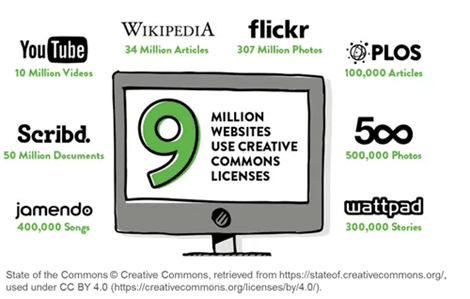
Statistics on the Creative Commons website (stateof.creativecommons.org) indicate that approximately (one and a half billion) works have been licensed using various types of Creative Commons licenses. The following image shows the most important websites that have used these licenses, along with the number of works that have been licensed:
Below we will show two examples of how to use Creative Commons licenses. The first example is for an image on the Internet, and the second example is for licensing articles on Farhan’s blog.
Example 1: The following image illustrates one of the fundamental (assumed) differences between the terms (All Rights Reserved ©) and (Some Rights Reserved CC). All Rights Reserved assumes that people are inherently bad and that the law should be used to control them, while (Some Rights Reserved) assumes that people are inherently good and that a healthy culture is required to preserve/support everyone. Below the image, we can see how it is licensed under the Creative Commons Attribution-NoDerivatives (CC-BY-ND) license, as requested by the source (@bryanMMathers) from which we copied the image.

(Copyright vs. Creative Commons) by (@bryanMMathers) licensed under (CC-BY-ND)
Example 2: In this example, we will explain how to license any article we wish to use from Farhan’s blog, as we previously indicated that the blog’s articles are licensed under the Creative Commons Attribution-NonCommercial-NoDerivatives 4.0 International license.
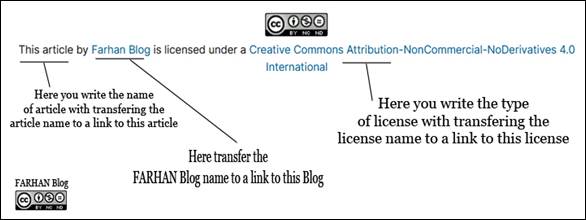
Finally, it should be noted that you can refer to the Creative Commons website to find out all the details related to licenses. You can also use the book (Creative Commons User Guide) by Simone Alibrandi/translated by Professor Heba Farid, which contains comprehensive details about the topic of Creative Commons.
The following video from the (U of G Library) YouTube channel gives a quick overview of Creative Commons licenses:

This article by Farhan Blog is licensed under a Creative Commons Attribution-NonCommercial-NoDerivatives 4.0 International


 مدونة فرحان