

MEXT Scholarship

The (MEXT) Scholarship is a scholarship provided by the Japanese government 🎌 where the word (MEXT) refers to (Monbukagakusho) or (Ministry of Education, Culture, Sports, Science and Technology). It is known that there are two ways to apply for the scholarship: applying through embassies (Embassy Recommendation) and applying through universities (University Recommendation). The scholarship also comes in several forms, including: a research period scholarship, a master’s degree scholarship, a doctoral scholarship, and other specialized scholarships.
Stages of applying for the MEXT scholarship grant through embassies

First, applicants must go to the website of the Japanese embassy in their country to make sure of two important things: 1- Whether the application is in paper or electronic form. 2- The timeline for applying and post-application procedures for the scholarship. Here, you can use the Japanese Ministry of Foreign Affairs website from here to access the embassies’ websites. After learning about the above, you can benefit from this article, which includes a comprehensive and brief explanation of most matters related to the MEXT scholarship.
In this article, we will limit ourselves to talking about the MEXT scholarship for research students (research period or master’s or doctoral course) which is applied for through embassies. The scholarship application process includes the following: scholarship application announcement, submission of papers to the embassy, initial examination by the embassy which includes examination of papers, written exam and personal interview, communication with universities and requesting provisional acceptance, resubmission of the (Placement Preference) form to the Japanese embassy based on the result of communication with universities, second examination of the applicant’s file by the scholarship administration (MEXT), informing the student of the final result, travel procedures, arrival and registration at the university.
Stage 1: Submission of application documents

This stage begins immediately after the announcement of the opening of the application for the scholarship, where the applicant prepares and sends the required papers to the embassy where he is supposed to later take the written exam and follow up on the rest of the procedures for acceptance into the scholarship, where all the required papers are sent by the embassy’s mail (paper or electronic), and here a specific time period is determined within which the papers are accepted by the embassies.

Documents required to apply for the MEXT scholarship
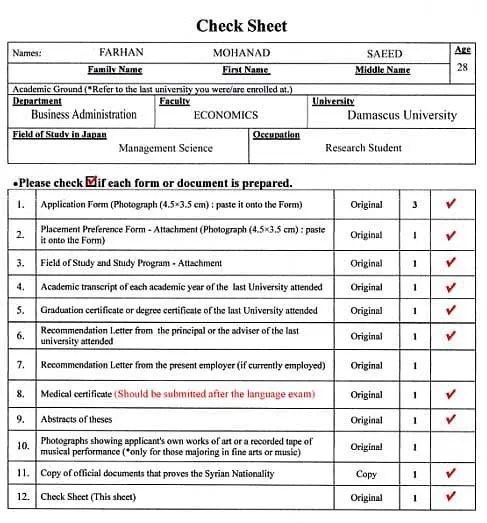
It is preferable for the applicant to first review the Check Sheet file (which can be downloaded by clicking here), which gives a summary idea of the required documents. We will explain the required documents as they appear in the Check Sheet below:
1-Application Form: This is an Excel or PDF file that the applicant fills out with personal information, social and educational background, in addition to information related to other details and matters such as details related to the applicant’s plan to study in Japan (in terms of the type of program he intends to apply for and his motivation for studying in Japan, etc). A personal photo (for the three copies of application form) is pasted in the designated place on the application form after printing it, or an electronic photo can be added to the Excel (or pdf) file before printing it (or send it by email), noting that the original copy must be in color in this case.
The application form (pdf) for the scholarship can be obtained here.
2-Placement Preference Form: This is a PDF file that the applicant fills out with personal information, in addition to specifying the field of study that the applicant will apply for in Japan with the details related to it. Then the applicant specifies three universities with the name of the school (college) in each university and the name of the academic supervisor in each school (this paper is submitted initially, but communication with universities to obtain provisional acceptance begins after passing the personal interview stage).
An example of the Placement Preference form can be found here
The Placement Preference form can also be found here
3-Field of study and research plan: This is a (word) or (pdf) file containing information related to the applicant’s name and nationality, his previous and current field of study, the research topic he intends to do in Japan, i.e. the title of the research, and the research plan he intends to follow in Japan, i.e. the research methodology.
It is worth noting that this file is considered one of the most important files for applying for the scholarship because it is considered a basic criterion for judging the applicant’s competence. Here, it is preferable to limit writing to two pages, noting that writing more than two pages is permitted (there is no objection to writing on one side of the page or both sides).
The scholarship file (field of study and research plan) can be downloaded from here.
4-The last transcript obtained by the applicant: Here it should be noted that the word (Original) in the (Check Sheet) does not mean the student’s original transcript, but rather the certified copy (an exact copy), and the word (Copy) in the (Check Sheet) means a copy (black and white only). Do not submit the original copy of any certificate because the submitted papers are not recoverable 🙂.
Here it should be noted that if the transcript is not in English, it must be translated into English or Japanese (in the event that all papers are submitted in Japanese) and then the translation attached to the copy in the native language must be certified.
5- Graduation certificate for the last degree obtained by the applicant: Here, the same steps mentioned in the previous paragraph must be followed.
6-Recommendation Letter: This can be obtained from the academic supervisor or the dean or vice dean of the college in which the applicant studied or is studying. It should be noted here that any form of recommendation letters is accepted, meaning that the form included in the scholarship application files is not mandatory. If the applicant wishes to use the scholarship form, he must write his name, the name of the recommender, his academic title, place of work, the work or home address of the recommender, the phone number and email of the recommender, and then ask the recommender to answer the questions (the space immediately after the question on the same line can be used as well as the space directly under the question) as well as the type of recommendation (I strongly recommend, I recommend, I recommend with reservations), and then write any additional notes, and then sign the recommendation letter and put the date.
After preparing the recommendation letter:
– If the application is via email: The paper is scanned and converted into a clear (pdf) file.
– If the application is on paper: The recommendation letter is placed in a special envelope (A4 or A5 after folding the paper) and then the envelope is closed and stamped with the college or university stamp at the closing point and then signed (by the recommender) above the stamp. The phrase (confidential) is then also written on the back of the envelope (it is possible to print the phrase in advance on the envelope or write it by hand or print a small piece of paper with the phrase written on it and then stick it with oho adhesive on the back of the envelope). The following image illustrates what is meant by the above.

An example of a recommendation letter template can be downloaded here
The scholarship recommendation letter template can also be downloaded here
7-Medical certificate: It is a single page filled out by the examining physician, and the applicant submits it with the previous papers immediately.
Due to the circumstances that countries are currently going through, some new instructions have appeared regarding the application, and here you can review the instructions of each Japanese embassy according to the country to which the applicant belongs, as the submission of this paper can be postponed until after the written exam for many nationalities.
The scholarship medical certificate form can be downloaded from here.
8- Summary of the scientific thesis (if any): Here, a summary (two pages, for example) of the scientific thesis completed by the applicant is attached.
9- Language proficiency certificate (if available): The applicant must attach a certificate of proficiency in English or Japanese (if available). This may give the applicant an additional advantage (especially with regard to the Japanese language) and is also related to the period of time that the student may spend learning the Japanese language after arriving in Japan (usually six months).
10- A letter of recommendation from the current job (if the applicant is an employee): Here, the same steps mentioned in paragraph No. 6 regarding the academic recommendation letter must be followed.
11- A photograph(s) showing the applicant’s artwork or a digital audio file of a musical performance (only for fine arts or music majors).
12- An official document to prove nationality (a copy of a passport, for example).
13- Check Sheet: It is a sheet (one page) filled with the applicant’s name, age, academic background, the field he will study in Japan, and the student’s occupation. Then, a mark ( ) is placed (for the prepared papers) in the designated place opposite the names of the required papers. After that, the Check Sheet is printed in color. It is worth noting that there is a sheet specific to each embassy. The sheet in this article was downloaded from the Japanese Embassy website in Syria (for Egyptian students, the file is of Excel type and there are additional questions after the boxes of the previous papers).
An example of a Check Sheet can be found here.
Here it should be noted that it is necessary to avoid using staples for papers ( ) and replace it with using clips (
 ).
).
After completing the preparation of the previous papers:
– If the application is via e-mail: All the previous papers are scanned and converted into clear (separate) (pdf) files, then sent in one message via the e-mail address specified by the embassy, noting that the size of the complete files is less than 10 megabytes, and if the size of the combined files is more than that, the files can be sent via two messages with an explanation of that, and the documents must meet the following criteria: There is no missing part or page, the document is clear and readable with good alignment, no shadow that hinders reading the document, the page is not tilted, the text must not be darkened. (Unreadable documents will not be examined), and the applicant must receive an e-mail response upon receipt of the papers by the embassy, and if he does not receive a response within a day or two, he must resend the papers via e-mail or send an inquiry to the embassy.
– If the application is on paper: The previous papers are placed in a large envelope with the name of the scholarship written on the back (in red) with the name of the country to which the applicant belongs. For example: (MEXT Scholarship, Syria) or we write 2024 instead of the country name according to the instructions of each embassy. The text can be pre-printed on the envelope or printed on an external sheet and then affixed to the envelope using (oho) adhesive, then the envelope is sent via the mail address of each embassy or delivered by hand if the embassy’s instructions indicate so.
Stage 2: Paper Screening

At this stage, the embassy examines the applicants’ files to choose the most suitable ones. At the end of this stage, successful applicants are notified of the date and place of the written exam, noting that no messages are sent to students who are not accepted at this stage.

Learn about the Turkish government scholarship here
Stage 3: MEXT Written Exam

At this stage, students who have passed the previous stage (paper examination) will be subject to a written examination in both English and Japanese. It should be noted that proficiency in Japanese is not mandatory to apply for the examination, but it is an additional advantage to strengthen the applicant’s file for the scholarship. Also, having a certificate of proficiency for a certain degree of Japanese may exempt the applicant from spending the first period of the scholarship learning the Japanese language (please refer to the application instructions for full details).
To save the time of blog visitors, I have collected the written exam models for the years (2007) to (2020) in one compressed file that can be downloaded directly via the following link:
Download the written exam forms for the MEXT scholarship

For more information about the written exam, you can read the following article by clicking here.
Stage 4: MEXT Personal Interview

At this stage, a personal interview is conducted with students who have passed the previous stage (written exam):
– The interview team usually consists of three individuals (official members of the embassy and university professors).
– You should try to convey your study goals, the importance of the study and the expected results in clear and simple terms, as the interview committee may not include anyone from your specialty.
– The interview questions are often the questions generally known in interviews related to academic admissions, such as: Introduce yourself, what do you want to study, why do you want to study this major, why do you want to study in Japan and other questions.

For more details about the interview, you can read the following article by clicking here.
Stage 5: Contacting with Universities

At this stage, the successful applicant in the previous stage (preliminary examination) contacts Japanese universities to obtain provisional university acceptance from them (either acceptance to conduct research or acceptance for a master’s or doctorate) before August 25. At this stage, it is permissible to contact two universities at the same time to obtain two letters of acceptance. The applicant must contact the International Student Affairs Department at the specified university or academic supervisors. The applicant must also provide the university he is contacting with with a certificate of success in the previous stage (issued by the Japanese Embassy) in addition to the same previous papers that he submitted after stamping and returning them from the Japanese Embassy, with the exception of the Placement Preference form and the medical examination certificate, which must not be submitted to the universities at this stage. Here, copies of the previous papers are often sent via email and a response from the universities is awaited.

Learn about the German government scholarship DAAD here
Stage 6: Obtaining acceptance and second examination

The applicant amends the Placement Preference form based on the results of communication with the universities and resubmits it to the Japanese Embassy with copies of the acceptance letter from the university. The Embassy then contacts the MEXT Scholarship Administration, which in turn conducts a second examination of the applicant’s file. Based on the result of the second examination, the applicant is informed of his/her acceptance of the scholarship through the Japanese Embassy. Here, for applicants who have obtained temporary acceptance to enter a master’s or doctoral course, they will be accepted directly to study in the course they have chosen without going through the stage of irregular students. This can be explained in the following image:


Learn about the British government Chevening scholarship here
The Last Stage: Traveling to Japan ✈️

The scholarship administration provides the costs of the economy-class plane ticket for travel to/from Japan, which includes travel from the applicant’s country directly to Japan or travel to Japan via a third country (specified by the applicant in the application).
Financial Benefits of MEXT Scholarship

– Students receiving preparatory education and non-regular students (research students): 143,000 yen per month (approx. US$1,335).
– Regular students enrolled in master’s degree courses or professional courses: 144,000 yen per month (approx. US$1,345).
– Regular students enrolled in doctoral courses: 145,000 yen per month (approx. US$1,355).
– A supplementary regional allowance of 2,000 yen or 3,000 yen per month (approx. US$20-30) may be added to the monthly scholarship amount for students studying or conducting research in designated regions.
– The scholarship also covers travel expenses to and from Japan, entrance and registration examination fees, and various fees at universities (please see the Application Instructions file for full details).
Additional References
–The study guide in Japan can be downloaded here.
-You can download the file of the main academic majors in Japan (by clicking here).
-The search file for universities, colleges and academic specializations for the year (2020) can be downloaded (by clicking here). Here, the results filtering feature can be used to narrow the search scope according to the applicant’s desire.
-The file of the academic courses (bachelor’s, master’s, doctorate) available in English (until May 2021) can be downloaded by (clicking here).

We remind you that it is preferable for the applicant to read the Application Guidelines file, which contains basic and comprehensive information related to applying for the research grant.

If you benefited from this article, do not forget to support us by sharing the article with those interested in scholarships. Also, do not forget to keep the article in your “Favorites” list to refer to it later.
Good luck to all


Subscribe to get the latest blogs
*-please check the spam folder if you didn’t receive the email

This article by Farhan Blog is licensed under a Creative Commons Attribution-NonCommercial-NoDerivatives 4.0 International



 مدونة فرحان