


In the following lines, I will mention a simple summary that explains the experience of publishing my first book, starting from the first idea I worked on six years ago (in 2015) until 2020, where I will mention in this article whatever information I have collected previously.
The Beginning of the Story
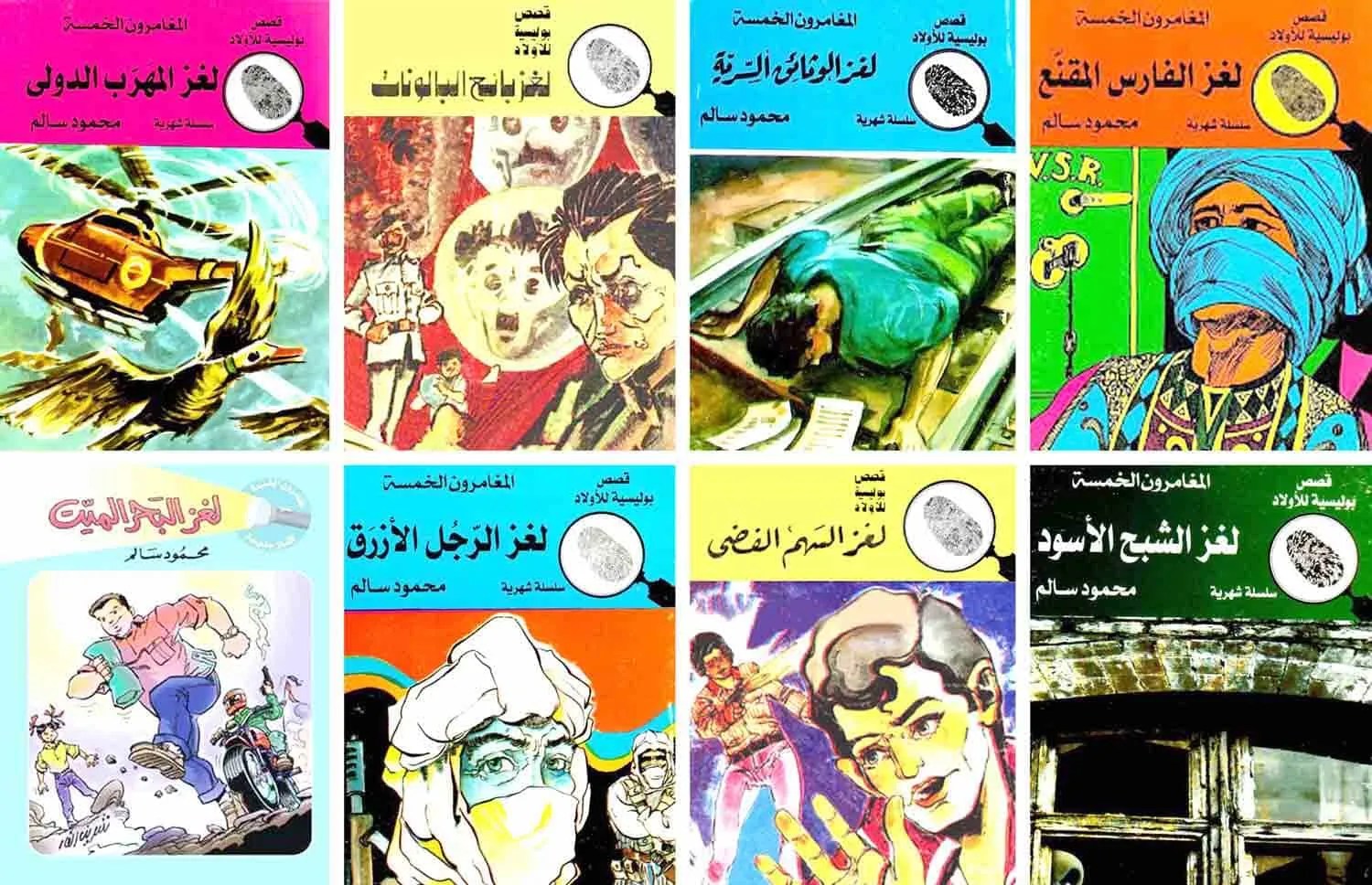
My first beginnings with writing were at the end of primary school after reading a large number of Egyptian detective stories by the writer (Mahmoud Salem), where I then tried writing several short stories from my imagination after replacing the five adventurers with other characters and changing the scene of the events to my residential area and the surrounding areas (Eastern Damascus), but this experience ended quickly, as one day there was a house cleaning that ended with me losing all the stories (which were often thrown in the trash). After that, I had an experience in writing short and primitive articles about aviation, some of which I was going to publish on my first website in 2004, which I was unable to publish (learn about my experience in establishing Farhan’s blog from here), later and over the days I continued writing articles, none of which I published and then no trace of them remained.

Balance Theory

The idea of writing this book came about when I first came across the ideas related to the Balance Theory in 2015 while searching for scientific sources (online) to use in my postgraduate studies at the time (Master’s degree). Here I noticed the importance of these studies and the valuable ideas they contained. At that time, I collected some of these studies and kept them to use them in preparing a doctoral thesis in the future. However, I was later forced to postpone starting to translate and write these ideas due to the circumstances that I went through during that period and what followed.

In 2018, I left for Egypt, and in the second half of 2019, I began a comprehensive investigation into the subject of Balance Theory and the ideas associated with it (in parallel with publishing my first research papers). At that time, the aim was to publish a research paper related to this theory, but I later expanded the subject to publish it in the form of a complete book. At that time, I devoted several months to an effort to accomplish this task, which was completed at the end of 2019, after which I moved on to preparing a copy of the initial draft of the book. After that, I began researching the subject of publishing the book in terms of publishing houses, types of contracts, number of copies, different publishing methods, and other matters.
The Dreams Stage

The day before presenting the book draft to the first publishing house, I was immersed in dreams: When will the publishing house print the book, will it print (500) or (1000) copies, how many editions will be printed later, what is the return I will get from publishing, the book’s distribution map and distribution outlets and other dreams that haunt most authors before publishing their first book, and here I will not prolong and will go straight to the subject. I presented the book to several publishing houses and the experience was as follows: The first publishing house, after reviewing a sample of the book, offered to publish the book at their expense and give me a number of copies as a gift in exchange for my waiving all rights associated with publishing the book in all its forms. After that, I went to a second publishing house, who in turn (before looking at a sample of the book) informed me that the publication would be at the author’s expense and that the number of printed copies would not be less than (1000) at a very large cost of up to (30) thousand pounds, in addition to the fact that the author would bear the responsibility of promoting and selling his book. Accordingly, I went to a third publishing house and offered them a sample of the book. After they looked at the sample, they agreed to publish and sent me a publishing contract (in partnership) where the author bears a financial amount (equivalent to thousands of dollars). Since it is a strong publishing house and provides strong services before and after printing the book, I tried to negotiate with them to convince them to bear the cost of publishing in exchange for adjusting the percentages of financial returns for the author, but they refused, and so I apologized for continuing publishing with them. After that, I received a second offer from them to reduce the financial amount due from the author, so I tried to negotiate again on the financial terms, but they refused, and so the publishing offer was cancelled. Here I was convinced of the necessity of not continuing on this path so as not to receive more shocks, and so I began to think about searching for a publishing house to help me only in obtaining a deposit number and an international numbering for the book and limiting myself to printing a limited number of copies at my own expense. So I reached out to a publishing house through an acquaintance who agreed to help me with the matter, and at this stage I re-adjusted the dimensions of the book and completely reformatted it, then I sent it to be printed directly with the cover file that I also designed.
Book Cover

Cover design can be done in one of two ways:
First: Simple design: Here the cover is designed by following simple steps, as this cover contains some simple elements, which are: the title of the book and the name of the author (written in a simple font without adding any effects), the logo of the publishing house and the background of the cover, which is often made up of one color. It is worth noting that this type of design can be easily done using Microsoft Word or Adobe Photoshop and other simple graphics programs without having a high level of experience in the subject. Most designers (including professionals) have recently resorted to using specialized programs and websites on the Internet that contain templates, texts and images ready to design this type of cover.
Second: Professional design: Here the cover is designed exclusively by a professional designer who has extensive experience in using graphics programs. In this type of design, the cover elements (background in addition to a specific image or drawing) are drawn by the designer. A ready-made cover background may be used that is taken specifically or obtained from several sources and is available for public use (Public Domain). It is often an image that does not contain bright colors or overlapping colors to a large extent so as not to affect the appearance of the other elements of the cover. In this type of cover, the designers’ innovations and creative ideas in designing the covers actually appear. The following video is an example of how these covers are designed:
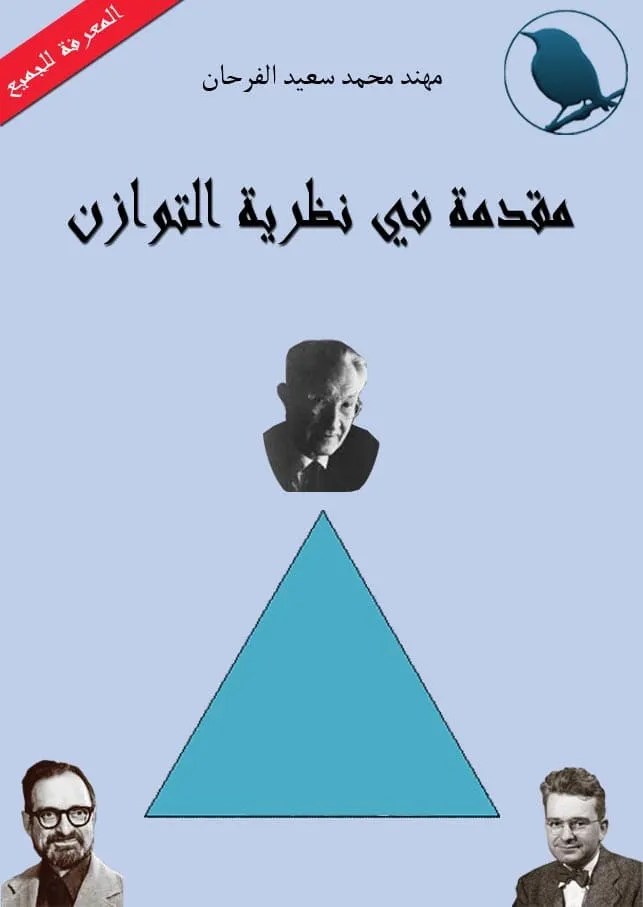
In the first stage, I designed a simple cover for the book, considering that it will be presented to publishing houses, which will most likely undertake to design a professional cover later. Accordingly, I used Microsoft Word to design the cover, to which I added the title, the author’s name, my blog’s logo, and images in the middle, with a triangle of one color in the middle (the balance triangle), as shown in the following image.

Then I started my experience with publishing houses (which I mentioned earlier), which ended with my conviction of the necessity of printing my first book at my own expense. Here, I had two options regarding the cover: either I rely on the simple design of the cover after making some modifications to it, especially with regard to the colors and the design itself, or I must get a professional cover from a professional designer. Here, you must have a personal acquaintance with a designer who will help you without incurring additional financial costs, or you will have to pay costs for the cover design service, noting that some may think that the cost is simple, so why not pay it? But if we combine this cost with other costs such as proofreading and reviewing the book, we will get the full price or most of the price of the first edition of the book. Given my unwillingness to continue with the simple cover design, in addition to the lack of any designer to help me design the entire cover, and since I will bear the cost of printing (limited edition), it is necessary to save this cost by doing most of the tasks related to designing the book (proofreading and reviewing, cover design) and other tasks that usually require paying additional money to those who do them. So an idea came to me: Why don’t I design the cover myself?
?Why don’t I design the cover myself
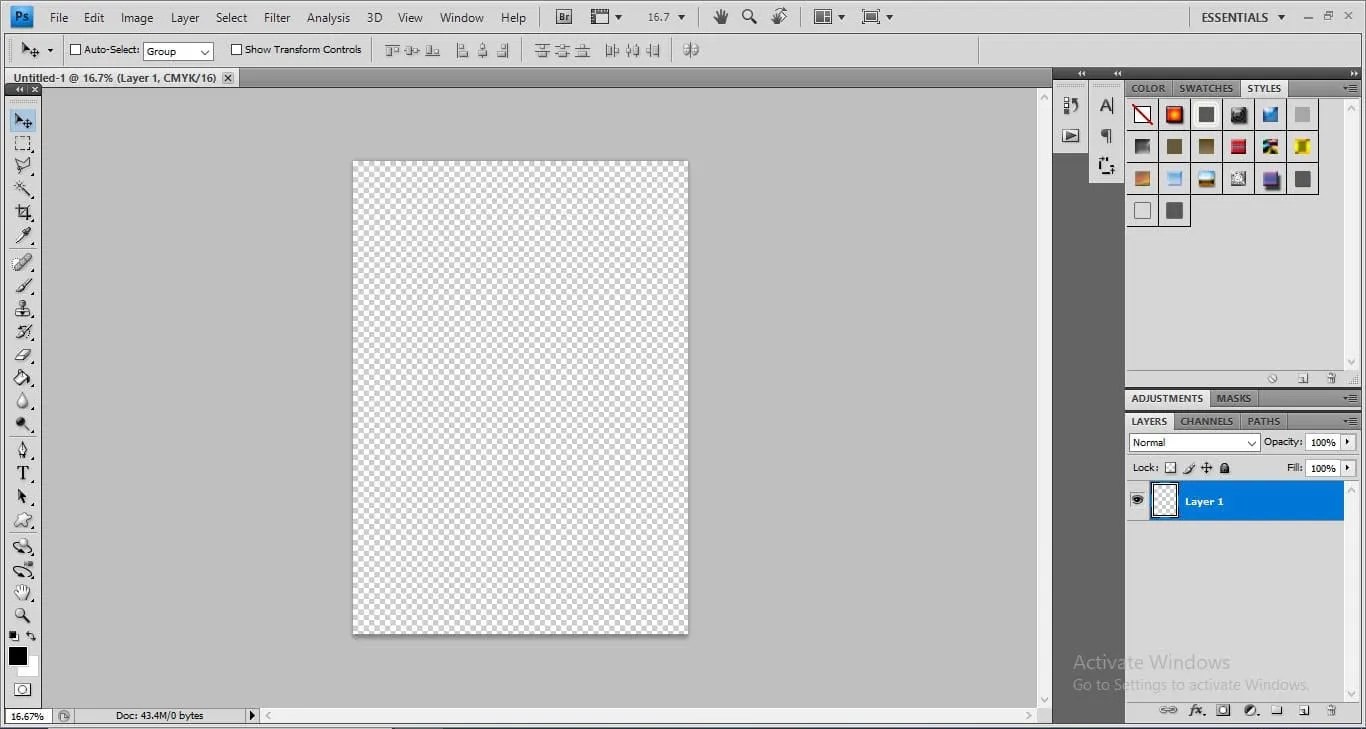
Since I have previous (simple) experience with Adobe Photoshop, I decided to use it to redesign the cover, noting that the version of Photoshop I am working on is an old version (Cs4: 2008). Here, I divided the work into several stages after relying on the same simple design elements for the cover. At first, I rearranged the positions of the cover elements, as we notice that in the simple cover, the elements were arranged from top to bottom: the title, images with the balance triangle, the author’s name, and the bird logo. Here, I designed four possibilities, each of which includes a specific arrangement for the previous elements, to finally reach the arrangement shown in the following image:
The previous design was adopted as a basis for completing the cover design, as the previous design included texts, a logo, and images with low resolution that were not suitable for printing. The design also did not include a background for the cover, and there was also the problem of the triangle in the middle that needed to be reconsidered in terms of form and content. Here, I rewrote the texts and included the images and logo with high resolution, then I tried a large number of background images to adopt one of them as the background for the cover, as nine images were chosen to be adopted later. These images were downloaded from multiple sites that contain a large number of images available for public use. As for the triangle in the middle (the balance triangle), the fixed color (blue) will be replaced with either a fixed image or a specific drawing. While searching for information about the famous mathematician Leonhard Euler, my eyes fell upon one of the drawings published in an article in Wall Street Journal. Before contacting the graphic designer, I downloaded it and modified it into a triangle. Since the original drawing was in the form of a square, the top of the triangle remained empty, so I filled it with a fixed color temporarily. Also, this drawing was of an inappropriate resolution for printing on a high-quality cover, so I placed it on the cover temporarily until I obtained approval from the graphic designer.

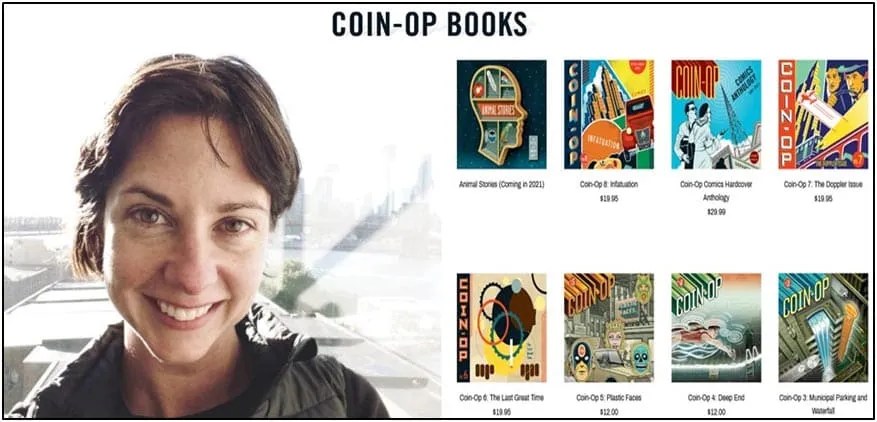
Later, I sent an email to the graphic designer, including the initial cover I had designed, as well as a request for permission to use the drawing on the cover. The designer responded that “if the book is educational (for universities or schools), the original drawing will be sent free of charge. However, if the use of the drawing involves commercial use, a fee will be charged for use.” I responded that “I wrote, proofread, reviewed, and designed the book’s cover myself to save money that I will use later to print a limited number of copies at my own expense. Then I will promote and sell the book myself as well. The book is primarily an academic book, but it also has a commercial nature on the other hand. Therefore, I am not sure that I can afford any expenses in exchange for obtaining the right to use the drawing.” The designer responded that she would search for the original drawing and send it to me in high resolution. She also offered to help me design the cover, where she completely reshaped the drawing into a triangle. She adjusted the colors of the illustration and the cover to be more harmonious with each other, and then thanked me for contacting her. It is worth mentioning that Maria Hoey is a graphic designer who founded the Coin-Op Books website in 1997 in the United States.
In the later stages of designing the cover and before printing it, many things must be taken into account, depending on the type of cover and the type of printing. These things include, for example: the size of the book cover and the dimensions of the cover elements from the outer borders of the cover as well as from the cover spin (between the front and back sides of the cover). Here you can see the following image and the explanation attached to it:
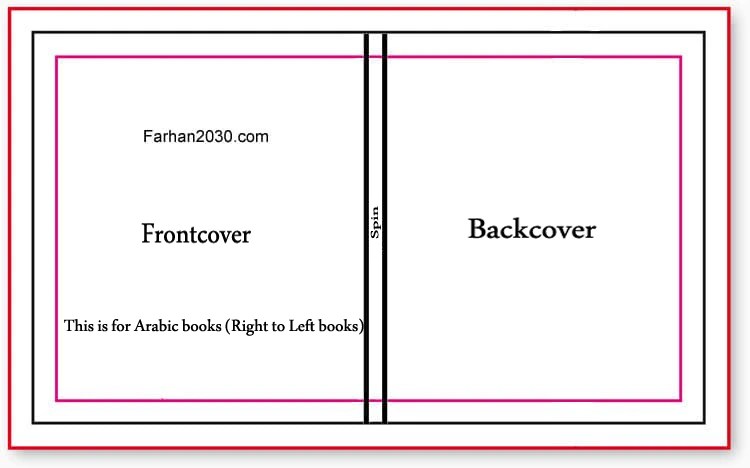
Red: Final borders of the design.
Black: Actual borders of the design after cutting.
Pink: Borders of the security spaces, which should preferably be at least half a centimeter away from the spin, depending on the type of cover to be printed. It is preferable to place the cover elements within the borders of the security spaces.
Security borders can also be added inside the spin of the cover, and it is also preferable to merge the images of the front and back covers (in an appropriate manner) in the area where they meet at the spin (if they are not originally one image).
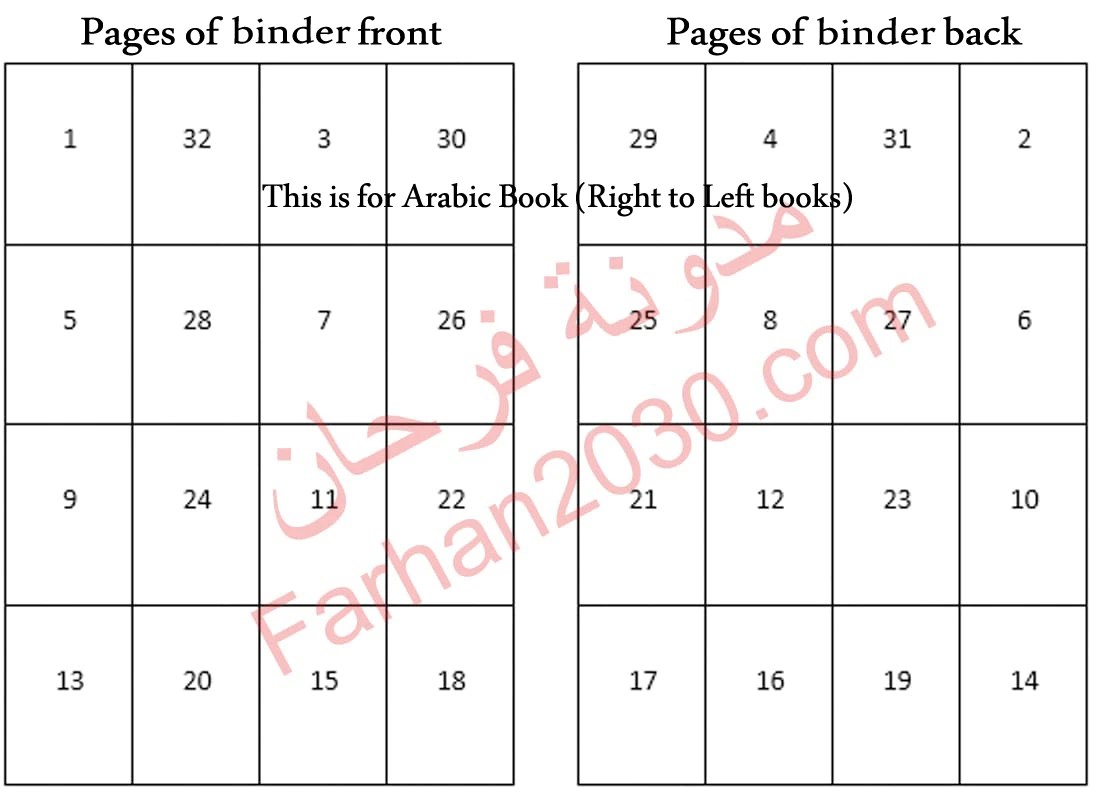
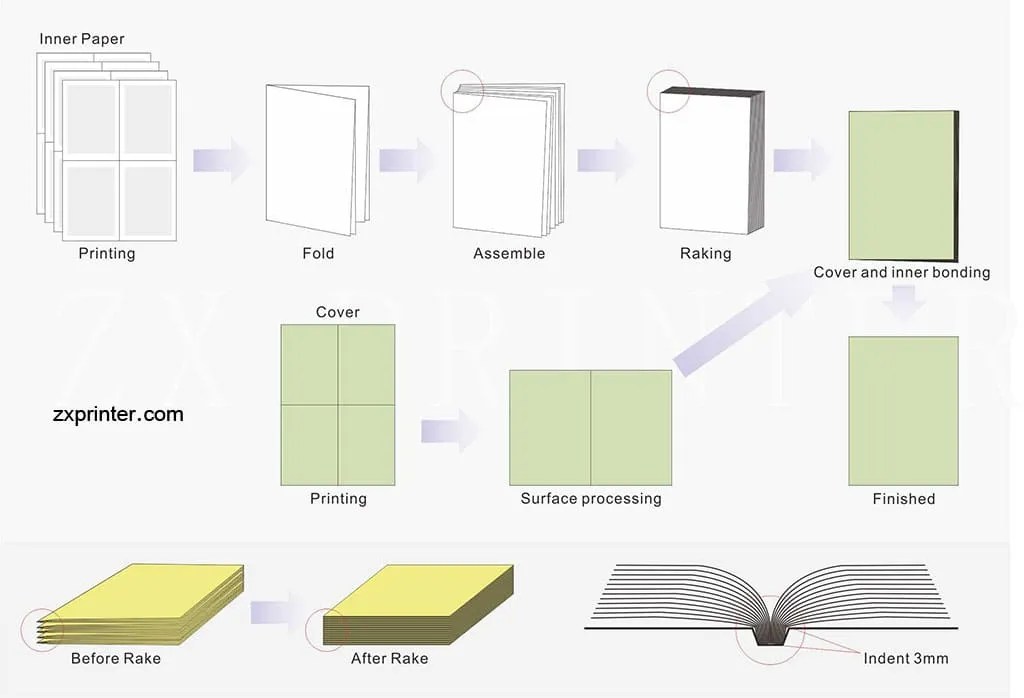
It is worth noting that the cover spin size is calculated by dividing the number of pages by the number of pages of the binder (the large sheet on which the book pages are printed on both sides). Let us assume, for example, that it is (16) and then multiplying the result by one percent of the paper weight. Accordingly, a book consisting of 128 pages with a paper weight of (1 g) will require printing 8 binders, and accordingly its cover spin will be (128/16)*0.1=0.8 cm. The following figure shows how to print the first 32 pages of the book on a single binder containing 16 pages (the binder could be 2, 4, 8, or any number of pages), then the rest of the binders are printed, cut, and assembled with the cover to produce the book in its final form:
Here, after consulting with whoever will print the cover later, I designed the dimensions of the book cover as follows:
-Design Height: 24cm + 2cm top + 2cm bottom (cutting space) = 28cm.
-Design Width: 17cm front cover + 17cm back cover + 0.75cm heel + 2cm right + 2cm left (cutting space) = 38.75cm.
There are also many things related to the color scheme used in the design, its characteristics, and many other things related to printing in general, which I learned about by looking at many websites, videos, and books on the Internet. For example, it is necessary to emphasize the design of the cover and all its elements with high resolution in order to avoid as many problems as possible that may appear later after printing the cover.
As for the back cover of the book, there are many things that we will not elaborate on here. The simplest of these is to take the final edge of the front cover (2 mm, for example) from the spin side and then extend it to the end of the edge of the back cover. This way, we maintain a single pattern that connects the two covers through the spin, thus avoiding as many problems as possible that may appear later in the heel of the book. Also, as for the ISBN barcode, after obtaining the ISBN (before printing the book), I used a free service available on the Internet to generate the barcode in a professional manner, and then I modified it using Photoshop before adding it to the back cover.
Of course, today it is possible to use artificial intelligence to design covers faster and with less effort.
Cover type
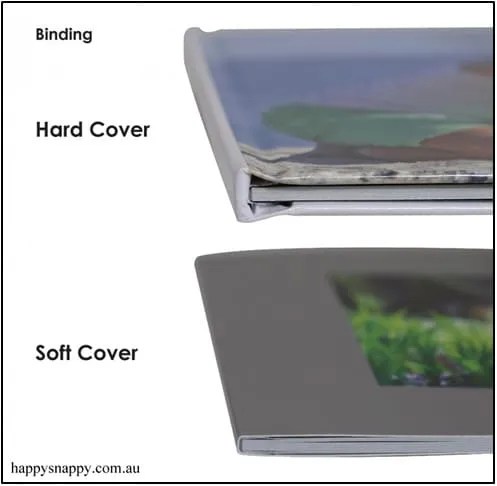
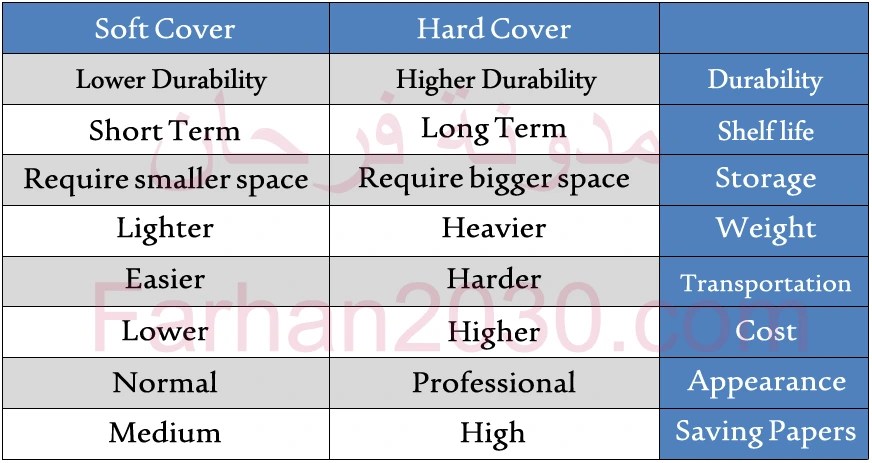
It is known that there are many types of covers, including hard cover, soft cover. There are many factors that must be taken into consideration when choosing the type of cover, including, for example: the cost, the number of pages of the book, the desire of the author or publishing house, the advantages or disadvantages of each type, and other factors. Accordingly, I chose the Hardcover to be the cover for my first book. It is known that Hardcovers are suitable for reference books (dictionaries, etc.), academic books, professional texts (medical brochures, law books), etc. The following image shows the most important differences between cardboard and regular covers:
Finally, I got a cover that combined simplicity and professionalism, with my own efforts and with the help of a professional graphic designer, and I was able to save costs that later helped me in printing the book.
After printing the book

After receiving the printed copies of the book and while returning with them, my joy was indescribable. I finally got the result of my efforts after five years of the first idea that came to my mind and a full year after I finished writing the first draft of the book. Thus, I removed another burden from the burdens that I faced, which means that there is not much left to start achieving part of my ambitions before presenting my book to publishing houses previously, but this time with completely self-efforts. Of course, at this stage, additional efforts must be made and a lot of patience must be possessed while promoting and selling the book. Here, I advertised the book on my blog page on WordPress and Facebook. I also collected some information about shipping companies and different shipping and payment methods. To increase the chances of marketing and selling the book, it can also be presented on various online bookstores such as (neelwafurat.com), (IngramSpark) and (Amazon Kindle) and others.




Subscribe to get the latest blogs
*-please check the spam folder if you didn’t receive the email

This article by Farhan Blog is licensed under a Creative Commons Attribution-NonCommercial-NoDerivatives 4.0 International



 مدونة فرحان