

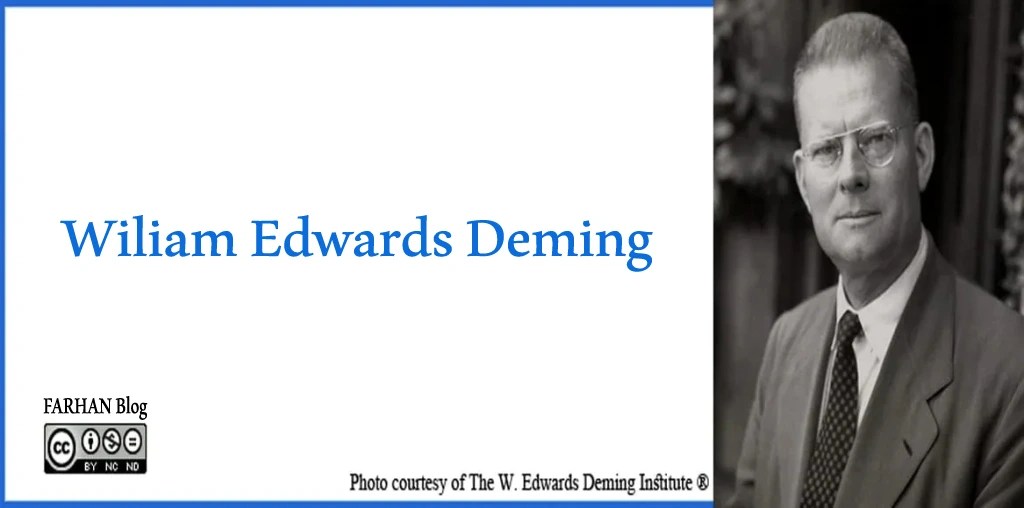

Name: William Edwards Deming.
Country: United States.
Birth: 1900 (Iowa, United States) / Death: 1993.
Education:
1928: Ph.D. in statistical physics from Yale University.
1925: M.S. in statistics from the University of Colorado.
1921: B.S. in electrical engineering from the University of Wyoming.

Biography:
An engineer, statistician, university professor, author, lecturer and consultant, in 1927 Deming was introduced to Walter Stewart, the founder of the concepts of statistical process control, at Bell Laboratories, where Deming began to move towards applying statistical methods to industrial production and management, influenced by Stewart’s ideas. Through his work at the Hadthorne Electric Plant in Chicago, he discovered the importance of statistical control in controlling the quality of work and production. He traveled to Japan after World War II at the request of the Japanese government to help its industries improve productivity and quality, where he put all his experience and energies into rebuilding Japan. Deming was so successful in his mission that in 1951 the Japanese government established an award named after him, which is given annually to the company that excels in terms of innovation in quality management programs. Deming was known as the “Father of Quality” in Japan, but recognition of his genius in this field was long overdue in his country (America). Deming was a professor of statistics at the Graduate School of New York University. (1946–1993), and a professor at Columbia University Graduate School (1988–1993) as well as a private business consultant, Deming developed sampling techniques that were first used during the 1940 U.S. Census. During World War II, Deming was a member of the five-person Emergency Technical Committee, which worked to compile U.S. wartime standards that were published in 1942, and taught Statistical Process Control (SPC) techniques to workers involved in wartime production. In 1947, Deming participated in early planning for the 1951 Japanese census. Allied forces were occupying Japan, and the U.S. Department of the Army asked him to help plan the census, brought in at the request of General Douglas MacArthur. In August 1950, Deming began working at the Hakone Convention Center in Tokyo, where he gave a speech on what he called “statistical product quality management.” Many in Japan credit Deming as one of the inspirations for what became known as the The Japanese postwar economic miracle of 1950–60, when Japan emerged from the ashes of war to become the world’s second-largest economy through processes influenced in part by ideas taught by Deming. From June to August 1950, Deming trained hundreds of engineers, administrators, and researchers in SPC techniques and quality concepts. Later, from his home in Washington, Deming continued to run his own consulting business in the United States. At this stage, Deming was largely unknown.


In 1980, Deming appeared in an NBC television documentary titled “If Japan Can…Why Can’t We?” The United States was facing increasing industrial competition from Japan, and as a result of this broadcast, demand for his services increased dramatically. Ford Motor Company was one of the first American companies to seek help from Deming in 1981. Ford’s sales were declining, and between 1979 and 1982 Ford had suffered losses of $3 billion. The company asked Deming for help to start a quality movement. Deming questioned the company’s culture and the way its managers worked. To the company’s surprise, Deming did not talk about quality, but about management. He pointed out that management’s actions were responsible for 85% of all problems in developing better cars. By 1986, Ford had become the most profitable American car company for the first time since the 1920s, with its profits surpassing those of General Motors. Deming realized that only employees really controlled the production process, so he put forward his theory called the Deming Circle, which he built on four axes (plan – do – check – act), and he advocated it as a means of improving quality, but Ignored by American industrial leaders in the early 1940s, his main ideas were focused on the following five areas: the Fourteen Principles of Quality Management, the Seven Deadly Diseases, the Sixteen Obstacles, the New Climate, and the Deep Knowledge System. The Deep Knowledge System states that: “The prevailing management style must undergo transformation. The system cannot understand itself. Transformation requires an outsider’s view. The purpose of this chapter is to provide an outsider’s view—a lens—that I call the Deep Knowledge System, which provides a map of the theory through which we understand the organizations in which we work. The first step is the transformation of the individual that comes from understanding the Deep Knowledge System, through which he will realize a new meaning for his life, for events, for numbers, for the interaction between people. Once the individual understands the Deep Knowledge System, he will apply its principles in every type of relationship with others. He will have a basis for judging his own decisions and for transforming the organizations to which he belongs.” Deming advocated that all managers need to have what is called the Deep Knowledge System. Deming was known for his compassion and concern for those he worked with, his strong spirit, his playfulness, and his interest in music, as he sang in A choir, he published several original pieces of music. In 1993, he founded the W. E. Deming Institute in Washington, and the Deming Collection at the Library of Congress in the United States contains a huge archive of audio and video tapes.

Publications:
-1993: Book (The New Economics).
-1986: Book (Out of the Crisis).
-1982: Book (Quality, Productivity, and Competitive Position).
-1967: Article (What Happened in Japan?).
-1939: Book (Statistical Method from the Viewpoint of Quality Control).
International Awards and Recognitions:
-1991: Wilbur Cross Medal.
1987: National Medal of Technology and Innovation.
Fellow of the American Physical Society.
References: (Wikipedia.com)، (www.toolshero.com)، (deming.org)، (quotes.deming.org).



Subscribe to get the latest blogs
*-please check the spam folder if you didn’t receive the email

This article by FARHAN Blog is licensed under Creative Commons Attribution-ShareAlike 4.0 International



 مدونة فرحان