

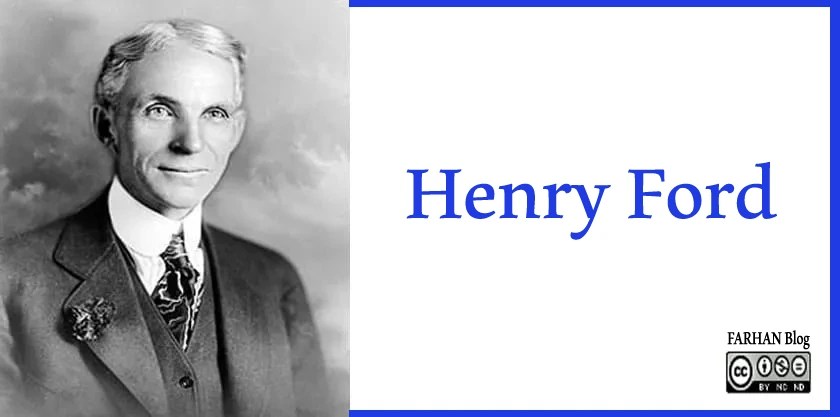
Name: Henry Ford.
Country: United States of America.
Birth: 1863 (Michigan, USA) / Death: 1947 (USA).

Biography:
He was the son of an immigrant family from Ireland, an American industrialist, a prominent economist, and the founder of the Ford Motor Company, and the sponsor of the development of the (assembly system) technology for mass production. The technology provided by the company helped sell cars at lower prices. He left school at the age of fifteen to work on his father’s farm. He was not interested in farming, so he moved to Detroit to work and train in a mechanical workshop. To increase his income, he worked in his spare hours repairing watches and alarm clocks. Henry Ford returned to the town of Greenfield after his father gave him 10 acres to start his own farm. He did not like working in farming and spent most of his time trying to build a steam-powered vehicle and an agricultural vehicle. With his unwillingness to stay on the farm, he returned to work at the Edison Lighting Company and rose from a trainee to an engineer in the company. During his work, Henry Ford read an article in the magazine (World of Science) about the German engineer (Niklaus Otto) who built an internal combustion engine. Ford developed an interest in cars, which were a new invention at the time, so Ford made his first engines which operating on petroleum that In 1893, and he made his first car in 1896. In 1903, Ford founded the Ford Motor Company. At the beginning of its era, the company produced only expensive cars, just as its competitors from other companies did. However, Ford quickly began working to make a simple and powerful car that would be within the reach of the majority of the people. Ford completed the first of these cars, the Model T, in 1908.


The original price of the Model T, $850, was too high for many buyers. To lower the price, Ford devised an assembly line system in which engine parts were arranged and installed by passing workers and technicians, with each worker performing a specific task, such as adding or tightening a part. This system helped shorten the assembly time of a Ford car from about 12.5 hours in 1912 to an hour and a half in 1914. The company began producing parts itself instead of buying them from outside suppliers at high prices. It also began shipping car parts to marketing locations, instead of shipping entire cars. The assembly company put the parts together, since the cost of transporting the parts was less than the cost of transporting the entire car. In addition, the company began producing glass and steel. As the company lowered production costs, Ford transferred much of the surplus to his customers. The price of the Model T fell to $500 in 1913, then to $390 in 1915, then to $260. In 1925, more than half of the cars sold in the United States between 1908 and 1927 were made by Ford, making the car affordable for middle-income families. In 1914, Ford raised the minimum wage for workers, paying them more than twice what their counterparts elsewhere were receiving. He also reduced the working day from nine hours to eight hours, which led to workers flocking to Ford branches looking for work. Ford introduced the workers’ profit-sharing scheme to encourage increased production, and allocated a portion of the company’s profits to workers. He also established branches of the company abroad. Henry Ford says that the idea of the assembly line came to him while he was visiting a meat preparation place in Chicago. The carcasses were hung on an overhead trolley and moved to stand in front of a group of workers, where that group would perform a specific operation to cut a specific part of the carcass, then the carcass would be moved to the next group, which would only cut another specific part, and so on until the end of the line ended with the skeleton of the carcass. Henry Ford came up with the idea that he could assemble the car in reverse, starting at the beginning of the line with the skeleton of the car (the chassis) and then each group of workers would install specific parts when the car stopped in front of them on the line (equipped with the required parts and trained in that specific process) until the end of the line ended with an assembled car in a faster and more accurate way. Within two decades, the car became available to most people, and farm owners were no longer isolated. The horse disappeared from the roads very quickly, which led to the abandonment of growing nutritious materials for the horse (hay) and planting other crops instead, which led to a revolution in the field of agriculture. Cities began to spread to distant areas, which led to a revolution in the field of construction and reconstruction. Roads and bridges were built to connect the country to each other, which led to a revolution in the field of communications. Ford had been interested in political issues for a long time, as he worked in the field of peace and worked to stop World War I in 1915, where he traveled with 170 other people to Europe at his own expense in search of peace, However, this group did not receive the approval of the American government, and failed to convince the warring countries to settle their differences, noting that he transferred his company’s production to military production in both wars. When World War II broke out, the company was transferred to producing the B.24 aircraft and the Jeep.


Ford ran for the Senate in 1918 and narrowly failed. He banned smoking in his institutions, considering it harmful to health. He built Henry Ford Hospital in Detroit at a cost of $7 million. He also built schools in various fields to provide educational experience using the single-classroom technique, modern teaching techniques, and participatory education. On January 13, 1942, Henry Ford obtained a patent for manufacturing a car with a plastic body that weighed 30% less than a metal car. He and his family also participated in the work of the Ford Museum in Greenfield Village, Michigan. In 1936, Ford and his son Edsel founded the Ford Foundation, one of the largest foundations in the world that provides grants for education, research, and development. Henry Ford died in the spring of 1947 at the age of 83, leaving behind a fortune estimated at $500 to $700 million, a global car company, and a car within everyone’s reach.

Publications: (Get it via Amazon)
-1930: Book (Edison As I Know Him).
-1926: Book (Today and Tomorrow).
-1922: Book (My Life and Work).
-1922: Book (Ford Models).
International Awards and Honors: 1928: Elliott Cresson Medal from the Franklin Institute.
References: (www.wikipedia.com)، (commons.wikimedia.org)، (www.britannica.com)، (arabamericannews.com).
The following video from the (This Day in Automotive History) YouTube channel shows the Ford production line:



Subscribe to get the latest blogs
*-please check the spam folder if you didn’t receive the email

This article by FARHAN Blog is licensed under Creative Commons Attribution-ShareAlike 4.0 International




 مدونة فرحان