

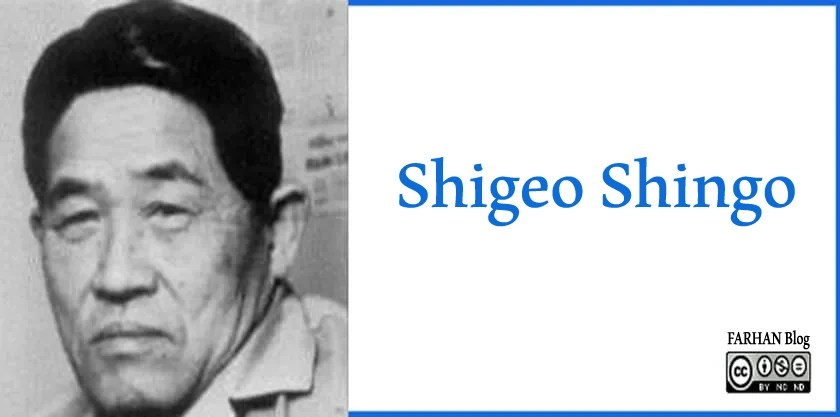
Name: Shigeo Shingo.
Country: Japan.
Birth: 1909 (Saga, Japan) / Death: 1990 (Tokyo).
Education: 1930: Bachelor of Industrial Engineering from Yamanashi Technical College.

Biography:
A Japanese industrial engineering and management consultant and trainer, he is considered an expert and a world leader in manufacturing practices and the Toyota production system. After graduating, he worked at the Taiwan Railway Factory in Taipei, and was responsible for measuring the factory’s production efficiency. In 1943, Shingo worked as a production manager at the Amano Factory in Yokohama. His work was of great value because it led to doubling the factory’s productivity. In 1945, after the end of World War II, Shingo began working as a consultant at the Japan Management Association (JMA), where he was responsible for providing advice to organizations on improving management and production processes. Among his clients he worked with were Mazda and Mitsubishi. In 1950, Shingo was offered a job at Toyota, where he was responsible for training operations that later contributed to reducing set-up times and eliminating human and technical errors in Toyota machines, which led to reducing the set-up time for each operation from two hours to one hour. The concept developed globally to be known later as (SMED). By the year 1977 Shingo pointed out that to achieve zero-defect production processes, the human aspect of factory dynamics had to be taken into account, which production engineers had previously overlooked. Shingo is perhaps better known in the West than in Japan as a result of his meeting with Norman Buddick, an American businessman and founder of Productivity Inc. in the United States. In 1981 Buddick traveled to Japan to learn about the Toyota Production System and came across Shingo’s books. Shingo wrote his study of the Toyota Production System in Japanese and translated it—poorly—into English in 1980. He was one of the few people with an understanding of Japanese quality control systems. Buddick took as many copies of this book as possible to the United States and arranged for Shingo’s other books to be translated into English. Buddick also brought Shingo to lecture in the United States. The significance of Shingo’s contributions has sometimes been questioned but has been largely confirmed by the views of his contemporaries who saw him as a contributor to basic TPS concepts such as the (Just-in-Time) and (pull) systems created by Toyota and researcher (Taiichi Ohno).


Publications: (Get it via Amazon)
-1988: Book (Non-Stock Production: The Shingo System of Continuous Improvement).
-1985: Book (A Revolution in Manufacturing: The “SMED” System).
-1982: Book (A Study of the Toyota Production System: From an Industrial Engineering Viewpoint).
-1981: Book (Toyota Production System).
International Awards and Certificates of Appreciation:
1970: Award (Yellow Ribbon Medal).
References: (Wikipedia.com)، (www.sites.google.com)، (www.toolshero.com).



Subscribe to get the latest blogs
*-please check the spam folder if you didn’t receive the email

This article by Farhan Blog is licensed under a Creative Commons Attribution-ShareAlike 4.0 International




 مدونة فرحان