

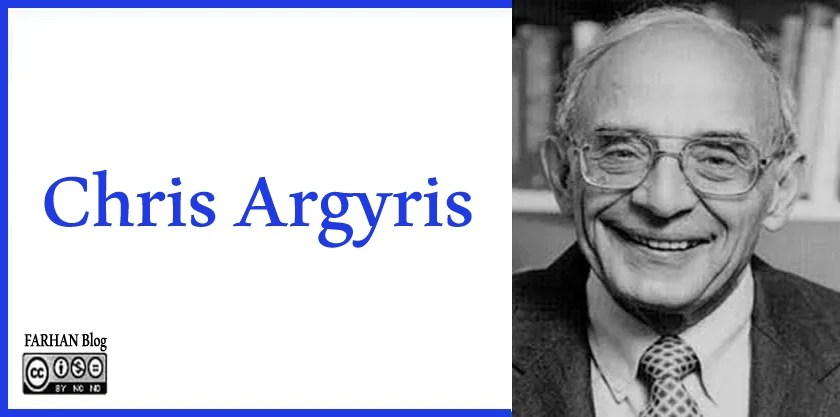
Name: Chris Argyris.
Country: United States.
Birth: 1923 (New Jersey, USA) / Death: 2013.
Education:
PhD in Organizational Behavior from Cornell University in 1951.
MA in Psychology and Economics – University of Kansas in 1949.

Biography:
Born to a family of Greek immigrants, in 1951 Argyris began his career as a faculty member at the Management Center at Yale University, eventually becoming a professor of management science. In 1971, he moved to Harvard University, where he served as a professor of education and organizational behavior. Until his retirement, he was active in consulting in Cambridge and Massachusetts. Argyris drew on the work of Kurt Lewin, the founder of social psychology, on feedback and participant observation. Argyris’ early research explored the impact of formal organizational structures and systems of control and management on individuals and how they responded and adapted to them. This research resulted in two books in 1957 and 1964. He then shifted his focus to organizational change, particularly exploring the behavior of senior executives in organizations, resulting in a book in 1965. He then moved to research into the role of sociology, resulting in three books in 1970, 1980, and 1985. His fourth major area of research was The theorizing—in large part done with Donald Schön on individual and organizational learning—resulted in three books (1974, 1978, and 1996).


Publications: (Get it via Amazon)
1999: Book (On Organizational Learning).
1996: Book (Organizational Learning 2: Theory, Method, and Practice).
1993: Book (Knowledge for Action).
1978: Book (Organizational Learning: A Theory of Action Perspective).
1974: Book (Theory in Practice: Increasing Professional Effectiveness).
1965: Book (Organization and Innovation).
1964: Book (Integrating the Individual and the Organization).
1957: Book (Personality and Organization: The Conflict between System and the Individual).
References: (Wikipedia.com)، (alharthi2000.blogspot.com).


Subscribe to get the latest blogs
*-please check the spam folder if you didn’t receive the email

This article by FARHAN Blog is licensed under Creative Commons Attribution-ShareAlike 4.0 International




 مدونة فرحان