

In the previous parts of this series, we talked about the topics of: organizational learning, organizational learning levels, single-loop learning, and double-loop learning. In this article, we will conclude the series by talking about the topic of the organizational learning process and its most important models mentioned in previous studies.
Organizational Learning Process
Management needs to pay more attention to the flow of information dissemination within the company in order to maximize the results of organizational learning that takes place within the company. This can be done by determining and implementing an appropriate coordination flow within the company so that information can be spread effectively and evenly to all employees, so that later all employees can act in harmony and in accordance with the policies set by the company [1]. Organizational learning research has provided us with insights into the processes through which learning can occur, which in turn helps us understand observed deviations in learning rates in firms [2]. The following table shows the most important models that the researcher reviewed after reviewing a large number of previous studies:

Table (1): The most important models of the organizational learning process in previous studies
| Study Name | Organizational Learning Process Elements |
|---|---|
| Huber, 1991 | Knowledge acquisition, information distribution, information interpretation, organizational memory |
| Slater and Nerver, 1995 | Information acquisition, information dissemination, shared interpretation |
| Martinez and Martinez, 2011 | Information acquisition, information distribution, shared interpretation, organizational memory |
| Argote et al, 2020 | Research, knowledge creation, knowledge retention, knowledge transformation |
| Scipioni et al, 2021 | knowledge creation, knowledge transformation, knowledge storage |
| Kaur and Hirudayanaj, 2021 | 4I model (Crossan et al, 1999): (Intuition, Interpretation, Integration, Institutionalization) |
The theory of formation and transformation of organizational knowledge
Before we begin explaining the previous models, we will clarify the theory of organizational knowledge formation and transformation, which includes the process of moving from tacit knowledge to explicit knowledge, then tacit knowledge, and so on. Studies have indicated that the interaction between tacit knowledge and explicit knowledge results in the formation of new knowledge (the first stage of the organizational learning process), and this interaction takes the form of a continuous spiral process that results in four patterns of transformations as shown in the following figure:
Figure (1): The process of knowledge creation

Socialization: This refers to interactions between individuals that lead to the sharing of tacit knowledge. Here, tacit knowledge is transferred without the use of language; for example, through observation, imitation, and practice [3] resulting from shared activities such as individuals spending time together or working in the same environment for a long time, which helps them understand the ways of thinking and feeling of others [4]. Here, there is no explicit knowledge and the knowledge here cannot be easily employed by the entire organization [5].
Externalization: It “requires the expression of tacit knowledge and its translation into comprehensible forms that can be understood by others”. This process requires techniques to “express ideas or images as words, concepts, figurative language (such as metaphors, analogies, or narratives), and visuals” [6]. Externalization involves the translation of highly individualized or specialized professional knowledge into an explicit form [7].
Combination: Explicit knowledge is transformed into more complex and explicit knowledge by recombining, sorting, or categorizing bodies of explicit knowledge held by different individuals. A group’s internal knowledge might be combined with knowledge from external sources. Typically, combination involves the dissemination of knowledge among the members of organizations, for example, through meetings or computerized communication networks [8].
Internalization: Internalization is “the conversion of explicit knowledge into the organization’s tacit knowledge” [9]. Individuals gather explicit knowledge that they identify as relevant to their domain to extend their tacit knowledge (e.g., by studying process documentation). They extend and re-frame their tacit knowledge as documented and verbalized experiences facilitate the internalization of knowledge [10].
As mentioned, the previous elements result in the creation of new knowledge, which is considered the first stage of the organizational learning process.
Models of the organizational learning process
In the following lines, we will explain the most important models of the organizational learning process included in previous studies.
(Huber, 1991) Study: George Huber proposed a four-stage model, after reviewing the literature related to organizational learning. These stages are: [11]
Knowledge Acquisition: If the lack of fit between an organization and its environment becomes too great, the organization either fails to survive or undergoes a costly transformation. In recognition of this, organizations scan their environments for information about changes. Huber also referred to the term “Corporate intelligence” which associated with the idea of searching for information about what corporate competitors are doing and how they do it. channels for acquiring this information include consultations, professional meetings, trade shows, publications, vendors and suppliers and, in less competitive environments, networks of professionals.
Information Distribution: The process of distributing information is one of the basic determinants of the occurrence and breadth of organizational learning. When information is widely distributed in the organization, and there are widely diverse sources of this information, it will be possible to retrieve information successfully, and the possibility of individuals and units being able to learn will increase. The process of distributing information leads to the occurrence of organizational learning on a wider scale.
Information Interpretation: It is the process by which information is given meaning, and it is the process of translating events and developing shared concepts. More organizational learning will occur when more and more diverse interpretations are developed. The amount of learning will increase as the organization and its employees are able to provide multiple interpretations of the available information.
Organizational Memory: Studies indicate that employee turnover creates a significant loss in the human components of an organization’s memory, and failure to anticipate future needs for required information will result in a large amount of information not being stored at all, or not being stored in a way that enables easy retrieval. In addition, members of the organization often do not know where the information they need is located, which is present at/or has been stored by other members of the organization. Huber discussed organizational memory within two basic ideas:
Information storage and retrieval: Organizations routinely store a great deal of hard* information, sometimes for operational reasons, or to meet reporting requests from other units or organizations. Much organizational knowledge about how to do things is stored in the form of standard operating procedures, scripts, etc. Managers and employees also obtain and store information in soft* form. Retrieving this information (especially hard information) is primarily associated with the introduction of computers as an essential part of the organization’s organizational memory.
Computer-based organizational memory: The automatic capture and advanced retrieval of information is computer-based organizational memory, which is often so accurate and complete that it surpasses the human components of organizational memory. Information needed to hire or train different types of employees, or to provide different types of services, as well as information transmitted internally using the organization’s e-mail, electronic bulletin board, or information exchanged outside the organization’s boundaries, is often contained on computers.
Finally, the previous processes of organizational learning (knowledge acquisition, distribution and interpretation of information) depend entirely on organizational memory.
(Slater and Narver, 1995) Study: This study indicated that organizational learning is a three-step process, which are:[12]
Information Acquisition: Information can be obtained from the direct experience of the organization or the experiences of other organizations or the organizational memory, which has been considered an important component in this era characterized by the increasing need for restructuring and reliance on temporary or contract workers. It is important that important information is encoded or recorded within information systems, operating procedures, work papers, the organization’s mission, routines or organizational stories.
Information Dissemination: Organizational learning can be distinguished from personal learning by the dissemination of information and the (organizational) interpretation of it.
Shared Interpretation: Researchers have suggested that it is important to ensure that all information is taken into account, and to achieve this the organization must provide forums for discussion and information exchange, which can be achieved through communication sites, integrated roles, face-to-face communication during meetings and joint tasks, as well as the use of information technology to form organizational advertising interfaces on topics such as competitive activities and technology development.
Figure 2 illustrates the organizational learning process and the boundary that constrains learning to the adaptive variety. The arrows indicate that generative learning requires knowledge development to reach beyond the adaptive learning boundary or new ways of interpreting information.

Figure (2): The organizational learning process model included in the study (Slater and Nerver, 1995)

(Martinez-Leon and Martinez-Garcia, 2011) Study: In this study, the researchers discussed many previous studies on the subject of the organizational learning process, emphasizing the studies of (Huber, 1991) and (Slater and Nerver, 1995); where they indicated that most previous studies were interested in acquiring information and not acquiring knowledge, as organizations acquire information to transform it into knowledge through the learning process, and accordingly, the term “knowledge acquisition” proposed by (Huber, 1991) can be replaced with the term “information acquisition”, and then it can be said that the organizational learning process consists of four dimensions or stages, which are: [13]
Information acquisition: The process by which information is gathered from internal and external sources (customers, markets, technology, competitors, and direct experiences). This process involves searching for information in both the organizational environment and memory, resulting in the storage of new information in working memory.
Information distribution: The process by which information (from multiple sources) is disseminated across the organization (individual and functional units, through formal and informal channels) leading to new information or understanding.
Shared interpretation: The process by which distributed information is given multiple, common and understandable interpretations, leading to the formation of knowledge. Here, meanings are given to information, events are translated and shared understanding is developed. This is the basic stage for future acquisition and interpretation of information, forming models of understanding and obtaining meanings.
Organizational memory: The means by which knowledge is retained for future use either in the organization’s specially designed systems or through rules, procedures and systems.
(Argote et al, 2020) study: This study indicated that the organizational learning process includes: search, knowledge creation, knowledge retention, and knowledge transfer. Search can be done inside or outside the organization and aims to find alternatives and their results. The term “search” refers either to refining existing knowledge and is called “Exploitation” or to developing new knowledge “Exploration”. Accordingly, there are two dimensions of search: Search Depth, which refers to the number of times existing knowledge is used, and Search Scope, which refers to the extent to which the organization discovers new knowledge. The search process is intertwined with both knowledge creation and knowledge transfer. As for the knowledge creation process, it is considered an essential element in organizational learning; as the organizational unit can form knowledge from its own experience or through the experience of other units. Here, organizations can obtain knowledge when they carry out a task; As organizational members learn how to best perform their individual tasks and who is best suited to perform a given task, tools are calibrated, routines and structures are refined, and members interpret whether the task has been performed successfully or unsuccessfully. Performing a task creates new knowledge in the organization. Knowledge retention involves embedding knowledge in a repository (including people, routines, and equipment). Knowledge contained in knowledge repositories can influence the future performance of the organization. For example, with experience, an organizational unit can develop knowledge about who knows what. When organizational members know whom to consult to solve problems, task performance becomes faster. Experience leads to knowledge about “who knows what”, which changes the organizational unit and improves future performance. The researchers pointed out that the knowledge acquired during learning may not last long, as knowledge may accumulate or decrease over time. Here, the researchers referred to the term “Depreciation” to refer to the decay of knowledge at the organizational level. They also referred to the term “Forgetting” to refer to the depreciation of knowledge at the individual level (it may be unintentional when the organization does not include knowledge in the organizational memory, or intentional when the organization intentionally excludes knowledge that has become inappropriate or useless or when the organization intentionally fails to include knowledge in the organizational memory). The depreciation of knowledge at the individual level can contribute to the depreciation of knowledge at the organizational level, which is also affected by many other factors such as: structure, culture, identity, competitors, degree of organization, employee turnover rate, technology, etc. The researchers mentioned – as an example – a comparison between three repositories in which knowledge can be included (technology, routine, individuals); The researchers indicated that knowledge embedded in technology was the least decreasing over time, followed by knowledge embedded in routines, and finally knowledge embedded in individuals. Here, knowledge acquired as a result of learning must be stored in what are known as knowledge repositories, which include individual employees, the organization’s processes and routines, tools, culture, and the transferable memory system (who knows what). Knowledge acquired as a result of learning can be embedded in employees such as managers or leaders, engineers, technical support staff, and front-line workers. In order for learning to turn into organizational learning, knowledge acquired by an individual must be embedded in supra-individual repositories such as routines, tools, and others. This in turn leads to the entrenchment of knowledge in the organization even if the individual leaves. Finally, knowledge can be transferred through several mechanisms such as: hiring employees, reverse engineering of products, obtaining knowledge from suppliers, vendors, consultants, conferences, scientific publications, and patents; Researchers have indicated that individuals are an important element in knowledge transformation, as well as tools and the information technology systems they include (knowledge management systems, digital repositories, social media), which can play an important role in the process of knowledge transformation across organizational, temporal, and geographical boundaries [14].
(Scipioni et al, 2021) study: The researchers in this study indicated that the organizational learning process includes the processes of knowledge creation, knowledge transfer and knowledge retention, which can be summarized as follows:
As for the knowledge creation process, previous studies have indicated that organizational learning activities seek to create new knowledge within organizations using both external sources (benchmarking activities with competitors, the use of consulting and professional services companies) and internal sources (brainstorming, simulation, job rotation and learning-by-doing activities) that are used to generate ideas, form proposals and clarify (explain) internal processes. Then comes the knowledge transfer process, which includes several formations of organizational groups that allow learning processes to occur (at different levels). Here, we can refer to what is called the “Community of Practice” (CoP) that stimulates knowledge transfer. It is represented by groups of people who are united by trust and common identity, who share interests and problems and increase their knowledge by acting according to recognized principles. Sometimes the previous community appears in parallel with formal work groups and project teams that constitute other contexts for knowledge transfer. Additional activities (training, lectures, meetings and research and development projects in cooperation with universities, research centers and partner organizations) are widely used to disseminate knowledge within and beyond organizational boundaries. The knowledge retention process refers to the processes that aim to receive and reuse knowledge at the organizational level, using specific processes (such as problem solving, learning from previous experiences, and best practices inside and outside the organizational context) that are transmitted across levels of organizational learning [15]. The following table illustrates the organizational learning process according to the previous model:
Table (2): The organizational learning process model included in the study (Scipioni et al, 2021)
| Organizational Learning Process | ||
| Knowledge Creation | Knowledge Transfer | Knowledge Retention |
| Consulting, Professional Services Firms, Simulation, Job Rotation, Learning by Doing, Brainstorming, Benchmarking | Community of practice, training/coaching, working groups, project teams, meetings/lectures, R&D projects with universities, research centers and partner organizations | Cognitive mapping, process mapping, problem solving, network analysis, best practices, lessons learned |
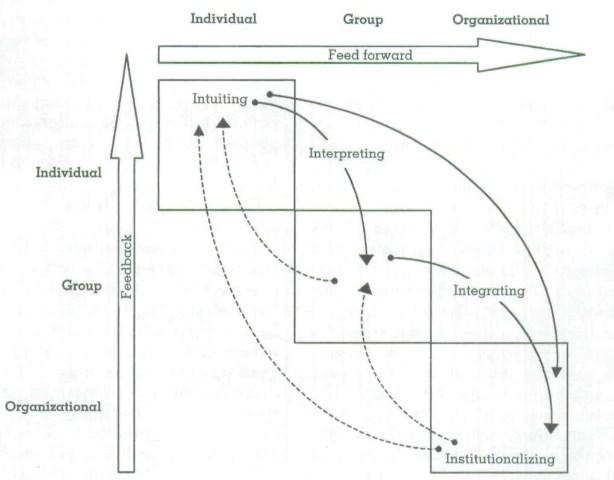
4I model: This model of learning was proposed by Mary Crossan et al. (1999) and summarized by Kaur and Hirudayaraj (2021) in their study; they indicated that the 4I framework is based on the sub-processes of learning that result in the creation and retrieval of knowledge within the learning organization system. The sub-processes include: Intuition, Interpretation, Integration and Institutionalization. Intuition occurs at the individual level when individuals attempt to recognize patterns within their personal experiences (which form the basis for their actions and performance). Intuition is generated in the subconscious mind, and thus it is based on the abundance of an individual’s experiences, and here there is no need for deliberation and planned decision-making. The feeling of what to do in a given situation comes naturally to an individual who has often faced similar situations in the past. However, at this stage, information remains tacit and requires metaphors to help transform intuitive insight into shared understanding. We then move to the interpretation stage, which allows for behavioral changes and the understanding of information stored in the subconscious, as individuals begin to develop cognitive maps around conscious elements. The process thus moves from the unconscious stage and begins to be influenced by the environmental context. Here, different people may respond differently to stimuli, which leads to the emergence of multiple interpretations of the same phenomenon. These ambiguous interpretations are best resolved through group integration. Anchoring or integration is a group process that includes dialogues, meetings, and conversations that allow individuals to discuss, make mutual adjustments, and negotiate existing interpretations. Finally, we move to institutionalization, which is the final sub-process when patterns of interactions and communication begin to transform into documentation, routines, and practices. Here, the knowledge developed through intuition, interpretation, and integration is invested in infrastructure and information systems. It can also be said that the flow of knowledge from intuition to interpretation and from interpretation to integration uses the mechanism of innovation and creativity (known as the process of exploration), while the transfer of knowledge from integration to institutionalization and from institutionalization back to intuition uses routine, knowledge transformation and gradual adaptation (known as the process of harnessing or exploitation)[16]. Here, many researchers have emphasized the need to balance exploratory learning with exploitative learning, and then managers can control the level of exploration and exploitation according to the vision and mission of the organization [17].
If we link the previous ideas with the levels of organizational learning, we can say that individuals learn through intuition, which is the process of recognizing familiar patterns from previous experiences. After that, individuals are connected to teams through the process of interpretation, which includes giving meaning to new knowledge and reshaping it through individual and collective efforts using metaphors, images and language. Then, learning occurs at the team level through the process of integration or integration, which requires developing a shared understanding through teamwork, dialogues, practices and joint modifications. Then, learning occurs at the organizational level through the process of institutionalization, which includes embedding individual and collective learning in the organization’s systems, structures, strategies, procedures and practices that help achieve collective benefit [18]. The following figure expresses the levels and elements of organizational learning as a dynamic process:
Figure (3): Organizational learning as a dynamic process
References
The primary source of the article is: Al-Farhan, Mohannad. (2022). The role of continuous improvement technique on organizational learning process: An applied study on the electrical appliances manufacturing sector. Master’s thesis, Faculty of Commerce – Menoufia University. / The thesis can be obtained by clicking here.
[1] Wiyana, K. and Sriathi, A. (2021). The effect of organizational learning on employee performance mediated by organizational commitment (Study at PT. Agung Jaya International). American journal of humanities and social sciences research, 5(1).
[2] Argote, L. et al. (2020). Organizational learning processes and outcomes: Major findings and future research directions. Management Science, Articles in Advance.
[3] Nonaka, I. (2018). A dynamic theory of organizational knowledge creation. Organization Science, 5(1).
[4] Nonaka, I. and Konno, N. (1998). The concept of “Ba”: Building a foundation for knowledge creation. California management review, 40(3).
[5] Basten, D. and Haamann, T. (2018). Approaches for organizational learning: A literature review. SAGE Open.
[6] Nonaka, I. and Konno, N. (1998). OPCIT.
[7] Basten, D. and Haamann, T. (2018). Approaches for organizational learning: A literature review. SAGE Open.
[8] Basten, D. and Haamann, T. (2018). Ibid.
[9] Nonaka, I. and Konno, N. (1998). OPCIT.
[10] Basten, D. and Haamann, T. (2018). OPCIT.
[11] Huber, G. (1991). Organizational Learning: The Contributing Processes and the Literature. Organization Science, 2(1).
* Hard information is often stored in the form of numbers (such as financial statements, payment times, stock returns), and can be easily retrieved, while soft information is often in the form of texts (such as opinions, ideas, rumors, economic forecasts, future management plans, etc.).(Refer to: Mitchell Petersen, 2004, Information: Hard and Soft, p6.)
[12] Slater, F. and. Nerver, C. (1995). Market orientation and learning organization. Journal of marketing.
[13] Martinez-Leon, I. and Martinez-Garcia, J. (2011). The influence of organizational structure on organizational learning. International journal of manpower, 32(5/6).
[14] Argote, L. et al. (2020). OPCIT. (Adapted by the researcher)
[15] Scipioni, S. et al. (2021). From barriers to enablers: The role of organizational learning in transitioning SMEs into the circular economy. Sustainability, 13(1021).
[16] Kaur, N. and Hirudavaraj, M. (2021). The role of leader emotional intelligence in organizational learning: A literature review using 4I framework. New horizons in adult education & human resource development, 33(1).
[17] Patky, J. (2020). ). The influence of organizational learning on performance and innovation: a literature review. journal of workplace learning, 32(3).
[18] Wiewiora, A. et al. (2020). Individual, project and organizational learning flows within a global project-based organization: exploring what, how and who. International journal of project management, (38).
To re-read the entire Organizational Learning series:
1-Organizational Learning: Introduction
2-Organizational Learning Level
3-Single Loop Learning
4-Double Loop Learning
5-Organizational Learning Process (This article)


Subscribe to get the latest blogs
*-please check the spam folder if you didn’t receive the email



 مدونة فرحان