


Through this series of articles (13 articles), we will learn about Balance Theory, of which were the basic ideas developed by the Austrian scientist (Fritz Heider). We will also learn about Graph Theory and its close connection with Balance Theory, and how did solving the Seven bridges of Königsberg Problem lead to the emergence of the first theorem in Graph Theory? What is Social Balance Theory, and how does this theory provide us with an important tool for analyzing the social system, and how do individuals tend to choose a state of balance in their interpersonal relationships? How did Egypt’s nationalization of the Suez Canal initiate a chain of events that included the tripartite aggression and subsequent states of balance or imbalance between the nations involved in the conflict? The Hungarian Spring and the dynamics of international relations (the Soviet Union, India, Hungary, the free world) on the situation in Hungary. The conflict in Syria and how the relations of friendship and hostility between countries (the United States, Russia, Turkey, Iran, Syria) produce stability or instability in Syria. Balance and imbalance in the context of sport and sponsorship with examples from the English Premier League and car racing in America. Gang violence in California and how the anti-gang unit uses Balance Theory concepts to predict violent events. Family Systems Theory and the importance of keeping the family network of relationships (the relationship between siblings/the relationship between parents and children) in balance.
All of the above will be discussed through this book which directed to a wide category of readers, including: decision makers, researchers in psychology, sociology, security sciences, international relations, as well as researchers in the fields of management and marketing.

Balance Theory
When entities compete within the same social system, tension is inevitable. This is true whether one is referring to partners involved in a romantic situation, organizations competing for resources or market shares, or nation states wanting to further a national agenda. For example, when nations decide to wage war they first carefully survey the larger landscape of international relations being careful to not only assess the strengths of one’s opponent but also to assess whether there are other nations that the potential opponent might pull into the conflict. Acts of interpersonal violence are no different. Even when committed by a single offender against a single victim, the decision of whether to engage in, or desist from, an aggressive situation is often shaped by assessing the roles and actions of others. The role of ‘third parties’, whether it is an audience or more an active participant instigating or deterring violence, has been implicated in conflict in a variety of social contexts, including interpersonal aggression, domestic violence and aggression between siblings, group conflicts in a feuding society, and collective violence. (Nakamura & Tita & Krackhardt 2019: 1-2)
Consumer psychologists state that “balance theory has proven to be one of the most enduring of the theories that have been applied to attitudinal phenomena, and it has been pursued with considerable rigor”. Balance theory claims that people, in general, prefer to have balance, order, and harmony in their lives. Therefore, every time there is imbalance, people would change their attitudes and/or behavior in a way that would restore balance. As a result, individuals will tend to like whatever is associated with what they already like and will tend to dislike whatever is associated with what they already dislike; otherwise, there will not be balance (Dalakas and Levin: 91). In other words, it can be said that the state of imbalance arises when there is agreement with the people we hate, or disagreement with the people we love. The lack of consistency involves the fact that “we like to agree with what we like or hate, and we also hate to disagree with what we love or hate (Sears, Freedman & Peplau 1985).
In the context of inter-group relations that are prone to conflict, like gang rivalries, another characterization of balance is of interest: when the structure is balanced, the boundary between friend and foe is clearly drawn (‘you’re either with us and are our allies or you’re against us and are our enemies’). In contrast, imbalanced triads represent a situation in which these boundaries are not so clear. An imbalanced triadic structure is characterized by ambiguity as to who one’s enemies are and who one’s friends are. For example, if a friend of a friend is an enemy, then there is uncertainty as to whether the focal person’s friend will be more loyal to them or to their other friend (the focal person’s enemy) (Nakamura & Tita & Krackhardt 2019: 4-5).
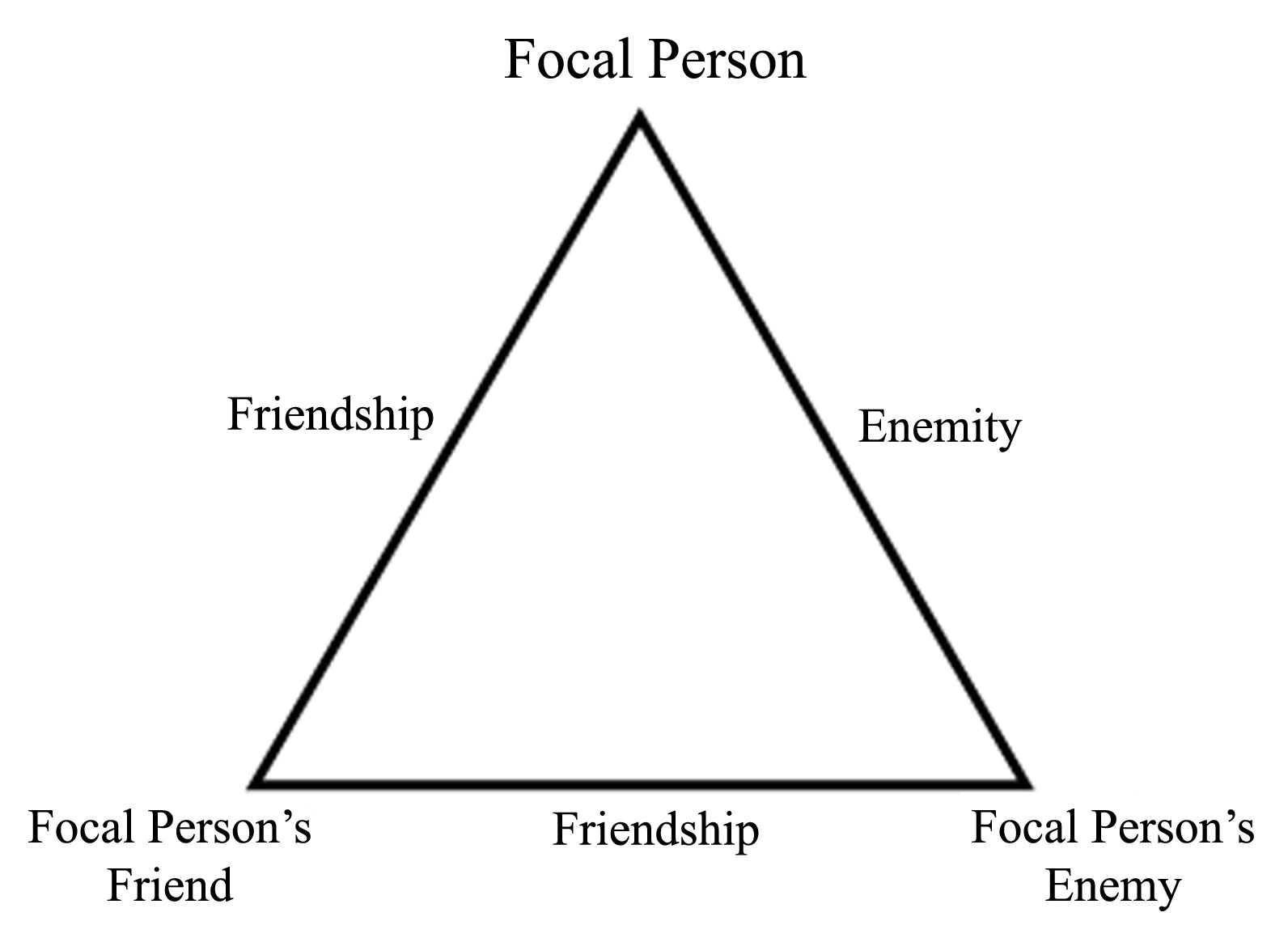
To illustrate this idea, we will mention the following examples that include three cases within common areas:
The first example: In a formation of three teams in the English Premier League (Liverpool, Manchester United and Chelsea), we generally notice the presence of negative (unfriendly) relationships between the three teams (they are of course greater between Liverpool and Manchester United), as shown in the following figure:

The question here is: If a match is played between two of the previous three teams, to which of the two teams will the preferences of the third team and its fans tend to be?
The second example: The following figure represents a relationship between three countries (X, Y, Z), where we notice a negative (unfriendly) relationship between (Y) and (Z), which in turn share a positive (friendly) relationship with (X).

In the previous example, an unbalanced state is achieved (we will explain it later), and accordingly, if we assume that there are negotiations between (Y) and (Z), and (X) plays an intermediary role between them:
-Could (X) preferences tilt during negotiations to either side (Y) or (Z)?
-In the event that the failure of negotiations leads to a war between (Y) and (Z), and (X) decides to depart from neutrality, to which side will (X) preferences (or even bias) tend to be?
The third example: In the following figure, we notice a very common case represented by a disagreement between the father and the mother, which often leads to the child becoming a victim between the parents:
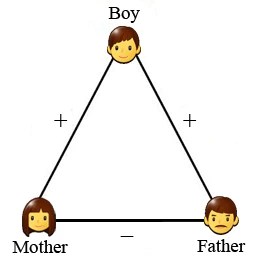
Here, we notice that the relationship between the father and the mother is negative (not friendly), at the same time, the relationship of the boy with both of his parents is positive (friendly), which leads to a state of imbalance (which we will explain later) and consequently, tension, and here it is possible to ask the intuitive question of whether the boy is in this case, more loyalty to his father or his mother?
However (From a lot of examples in our daily life) we noticed that, while tension may be inevitable, resolution of the tension by means of a violent act is not, and in fact, most tensions are resolved through non-violent means. Thus, domestic discord within a marriage does not always lead to domestic violence just as tensions between nation states do not always escalate into open warfare. Here comes the important question: What distinguishes those sets of tensions that are resolved peacefully from those that erupt in violence? To answer this question and the questions in the previews examples, one must consider the broader landscape of social ties that link members of a system to one another. For instance, negotiation and diplomacy can often resolve issues peacefully, but in all cases, the success (or failure) of efforts aimed at preventing a conflict depends upon relationships that extend beyond the parties directly involved in the conflict. Hence, the presence and absence of ties to other members in the social system as well as the nature of these ties must be considered in order to better predict the eruption of violence (Nakamura & Tita & Krackhardt 2019: 1) and this what we will be explained gradually in the next articles.

You can obtain the primary sources of this article (and at the same time support the blog) by purchasing the following book. Stay safe.

Subscribe to get the latest blogs
*-please check the spam folder if you didn’t receive the email




 مدونة فرحان